

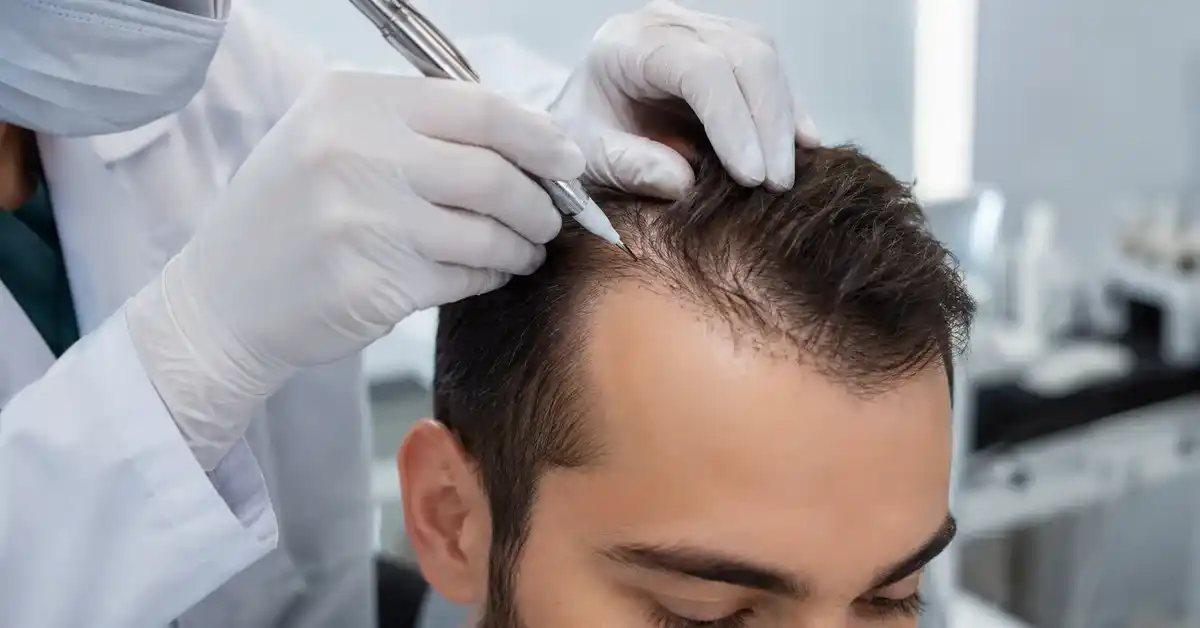
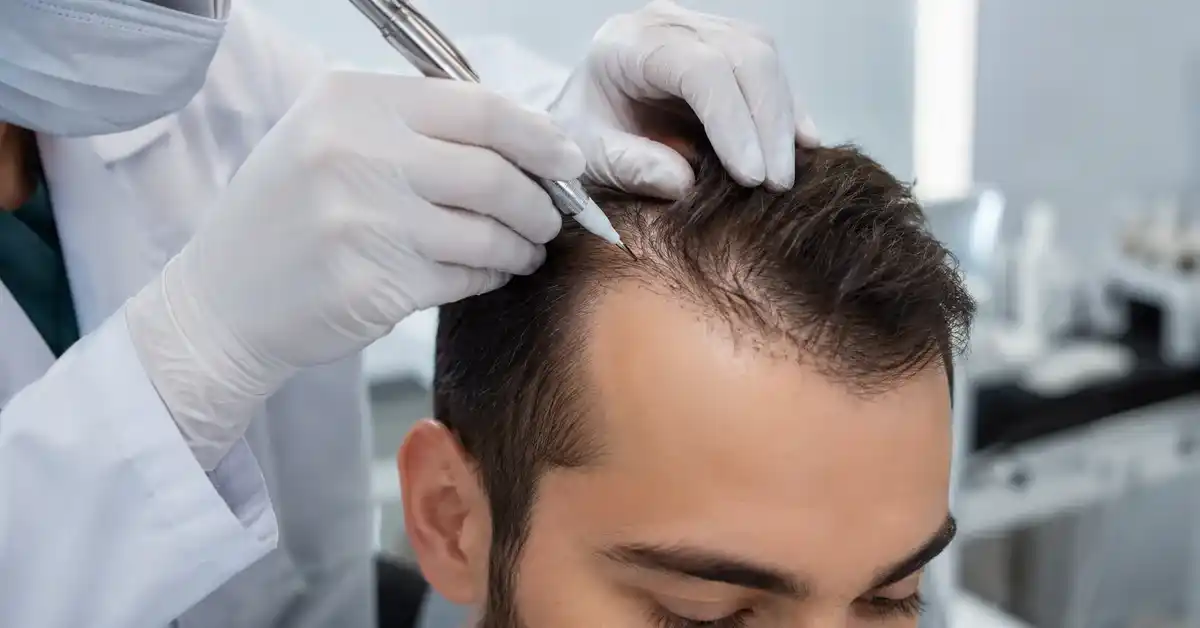
Hair transplant for partial baldness is an effective solution for people who have lost hair in specific areas, such as the hairline, temples, crown, frontal scalp, or a scarred area after injury or surgery. Not every patient needs full scalp restoration. Some patients have localized hair loss that can be treated with a targeted plan designed to restore density and improve appearance naturally.
Partial baldness may occur because of androgenetic hair loss, scarring, burns, trauma, traction alopecia, previous surgery, or certain skin diseases. This is why the process should begin with diagnosis, not with surgery. The doctor must understand why the hair was lost and whether the condition is stable or still active.
Several treatment options may be available, including FUE hair transplant, DHI hair transplant, hairline reconstruction, crown filling, scar hair transplantation, or combining surgery with supportive treatments such as PRP or medical therapy when appropriate. The best solution depends on the size of the area, donor hair quality, hair type, age, cause of hair loss, and realistic expectations.
At Safemedigo, partial baldness is evaluated with attention to the pattern of loss, donor area density, future hair loss risk, and desired result. The goal is not only to fill an empty spot, but to create a natural result that blends with facial structure, hair direction, and the surrounding hair.
What Is Partial Baldness?
Partial baldness means hair loss limited to a specific area while hair remains in other parts of the scalp or face. The affected area may be small, such as a gap in the hairline, or larger, such as the crown or frontal scalp. Sometimes it is obvious, and sometimes it appears only under strong light or when the hair is styled in a certain way.
Partial baldness differs from advanced baldness because the patient still has hair in most areas. Therefore, the goal is usually density improvement, hairline correction, or coverage of a defined spot rather than full scalp coverage. This requires careful planning so the transplanted area does not look separate from the natural hair.
Hair transplant may be an excellent solution for partial baldness, but it is not always the first step. If the loss is temporary, inflammatory, nutritional, hormonal, or caused by active skin disease, medical treatment may be needed before surgery.
Definition of partial baldness
Partial baldness is localized hair loss in one or more defined areas, with moderate or good hair density in other parts of the scalp. It can affect men and women and may appear in the hairline, temples, crown, mid-scalp, beard, eyebrow, or scarred scalp.
A small area does not always mean a simple condition. Sometimes the area is small but the cause is progressive, such as early genetic hair loss. In other cases, the area has been stable for years, such as an old scar, making planning easier.
The evaluation should answer key questions: What caused the gap? Is the hair loss still active? Is the donor area strong enough? How many grafts are needed? Will the transplanted area blend naturally with the surrounding hair?
Common areas affected by localized hair loss
Common areas affected by localized hair loss vary according to age, sex, and cause. In men, partial hair loss often appears at the hairline, temples, frontal scalp, or crown. In women, thinning may appear in the central scalp or frontal region, sometimes with preservation of the frontal hairline.
Common areas include:
- Frontal hairline.
- Temples.
- Frontal scalp.
- Crown.
- Mid-scalp.
- Surgical scars.
- Burn or trauma scars.
- Traction-related gaps.
- Beard patches in selected cases.
- Eyebrow gaps in selected cases.
- Areas after previous inflammation.
Each area requires a different design. Hairline work needs attention to angle, direction, and soft density, while crown restoration requires a circular pattern that follows natural hair flow.
Partial baldness vs complete baldness
The difference between partial baldness and complete baldness is the extent of hair loss. In partial baldness, the area to be treated is smaller and may require fewer grafts. In complete or advanced baldness, the treatment area is larger, and the donor area may not be enough to create high density everywhere.
In partial baldness, natural-looking results may be easier to achieve when the donor area is strong and hair loss is stable. However, one common mistake is transplanting a small area without planning for future hair loss around it. This can create an unnatural island of transplanted hair later.
This is why long-term planning is essential, especially in young patients with early androgenetic hair loss. The goal is not only to treat today’s gap, but to maintain a natural appearance if hair loss progresses.
Read about: Advantages and Expected Results of DHI Hair Transplant Technique
Causes of Hair Loss in Specific Areas
Causes of hair loss in specific areas vary, and they should not all be treated the same way. Some cases are suitable for hair transplant, some need medical treatment first, and others should not be transplanted until the disease is stable.
Diagnosis is the first step before hair transplant for partial baldness. If the empty area is caused by a stable scar, transplantation may be suitable. If the cause is active inflammatory scarring alopecia, surgery may fail or worsen the condition if performed too early.
Genetic hair loss can also start as partial thinning and later expand. For this reason, the doctor should assess hair loss pattern, age, family history, and miniaturization around the affected area.
Localized androgenetic hair loss
Localized androgenetic hair loss is one of the most common causes of partial baldness, especially in men. It often begins with hairline recession, temple loss, or crown thinning, then may progress over time. In women, it may appear as thinning in the central scalp or frontal region.
Hair transplant can restore the affected area, but it does not stop genetic hair loss in surrounding native hair. The patient may need supportive medical therapy to protect non-transplanted hair if recommended by the doctor.
Planning is especially important in young patients. The hairline should not be lowered excessively, and too many grafts should not be used in one area without considering future donor needs.
Scars, burns, and injuries
Scars, burns, and injuries can cause permanent localized hair loss because hair follicles in the affected area may be damaged or destroyed. These scars may result from accidents, burns, previous surgery, skin tightening procedures, or scalp trauma.
Hair transplantation into scars is possible in many cases, but it requires special evaluation. Scar tissue may have less blood supply and less elasticity than normal scalp, which can affect graft survival. Some patients may need a second session for better density.
Before transplantation, the scar should be stable and not inflamed. The surgeon should assess scar thickness, blood supply, and skin quality. Expectations must be realistic because growth in scar tissue may differ from growth in normal scalp.
Traction alopecia and skin diseases
Traction alopecia occurs when hairstyles repeatedly pull on hair roots, such as tight braids, buns, extensions, or other high-tension styles. Over time, follicles may weaken or become permanently damaged, especially around the front and sides of the scalp.
Skin diseases can also cause localized hair loss, including alopecia areata, fungal infection, psoriasis-related inflammation, autoimmune conditions, and scarring alopecias. In these cases, the disease must be diagnosed and controlled before transplantation is considered.
Hair transplant is usually not recommended when a disease is actively attacking follicles. The transplanted hair may be affected by the same condition. A dermatological evaluation is important when the cause is unclear.
Read about: Detailed Comparison Between FUE and DHI Hair Transplant Methods
Is Hair Transplant Suitable for Partial Baldness?
Hair transplant may be highly suitable for partial baldness when the area is stable, the donor area is strong, the cause is known, and expectations are realistic. In such cases, surgery can target the specific gap and improve density or hairline shape naturally.
However, not every case requires surgery. If the hair loss is recent, diffuse, caused by nutritional deficiency, hormonal imbalance, active inflammation, or temporary shedding, medical treatment may be the first step. Some cases should be monitored before surgery.
The right decision depends on examination, photos, hair loss pattern, donor area analysis, and sometimes lab tests or skin assessment. A successful transplant begins with correct diagnosis, not just a high graft number.
Who is a good candidate?
A good candidate for hair transplant for partial baldness has a defined area of hair loss, adequate donor hair, stable or controllable hair loss, good general health, and realistic expectations.
A suitable candidate often has:
- A clear localized gap.
- Good donor density.
- Relatively stable hair loss.
- Known cause of baldness.
- Good general health.
- No active scalp infection.
- Realistic density expectations.
- Understanding of the results timeline.
- Willingness to follow aftercare.
- Acceptance of supportive treatment if needed.
Patients with rapid, unstable hair loss or active skin disease may need treatment before surgery.
When is transplant not the best option?
Hair transplant is not the best option when hair loss is temporary or medically reversible. Hair loss caused by iron deficiency, thyroid disease, severe stress, medication, illness, or hormonal imbalance may improve when the cause is treated.
Transplant may not be suitable in cases such as:
- Active alopecia areata.
- Unstable scarring alopecia.
- Active scalp inflammation.
- Very weak donor area.
- Unrealistic expectations.
- Very young age with fast genetic loss.
- Unstable medical conditions.
- Desire for impossible density.
- Poorly vascularized scar.
- Unwillingness to follow aftercare.
In these situations, medical treatment, observation, or postponing surgery may be safer and more realistic.
Donor area evaluation
Donor area evaluation is essential in hair transplant for partial baldness. The donor area is usually the back and sides of the scalp, where hair follicles are more resistant to genetic hair loss. These follicles are extracted and transferred to the recipient area.
The doctor evaluates:
- Donor density.
- Hair thickness.
- Hair-to-skin color contrast.
- Hair curl or wave.
- Skin elasticity.
- Previous scars.
- Donor miniaturization.
- Safe number of grafts.
- Future transplant needs.
- Extraction pattern.
Even when the recipient area is small, donor hair must be used carefully because donor follicles are limited and do not regenerate after extraction.
Read about: When Do Hair Transplant Results Appear? Complete Timeline Explained
Hair Transplant Techniques for Partial Baldness
Hair transplant techniques for partial baldness include FUE, DHI, and sometimes FUT in selected cases. Supportive treatments may also be used. The choice should not be based only on the technique name, but on the patient’s condition and treatment goals.
In partial baldness, precision is essential because the transplanted area is often surrounded by natural hair. Grafts must be placed with matching direction, angle, and density so the result blends well.
Small areas may need fewer grafts, but they can be more sensitive aesthetically, especially the frontal hairline and temples where mistakes are easily visible.
FUE technique
FUE technique involves extracting individual follicular units from the donor area using small tools, then implanting them into the recipient area. It is widely used because it avoids a long linear scar.
Advantages of FUE for partial baldness include:
- Suitable for small and medium areas.
- No long linear incision.
- Relatively faster recovery.
- Flexible donor extraction.
- Useful for hairline correction.
- Useful in some scar cases.
- Suitable for patients who prefer short hair.
- Flexible graft numbers.
The success of FUE depends on careful extraction, graft handling, and natural placement in the recipient area.
DHI technique
DHI technique uses special implanter pens to place grafts directly into the scalp. It may be useful for selected density cases, especially when working between existing hair or in defined small areas.
Possible advantages of DHI include:
- Precise graft placement.
- Useful for selected density work.
- Good angle and direction control.
- May suit small areas.
- Helpful in some hairline cases.
- Reduced graft handling when performed by an expert team.
DHI is not automatically better than FUE in every case. The result depends on the team’s skill, graft quality, planning, and surgical design, not only the technique label.
Hair transplant for scars and small areas
Hair transplant for scars and small areas requires special experience. A small area may look simple, but it needs careful distribution to blend with surrounding hair. Scar tissue can be more challenging because it may not support graft growth as well as healthy skin.
For scars, the doctor may recommend a conservative number of grafts at first and then assess growth after several months. Some patients may need a second session to improve density.
Small areas such as a hairline gap, beard patch, or eyebrow gap require precise hair direction. Even a small angle mistake can be visible. Artistic planning is as important as graft number.

Steps of Hair Transplant for Partial Baldness
The steps of hair transplant for partial baldness begin with consultation and diagnosis, followed by treatment design, graft calculation, surgery, and follow-up. Each step affects the final result.
Partial baldness should not be treated as a minor procedure only because the treated area is small. Some localized areas are technically demanding because they are highly visible or surrounded by existing hair that must be protected.
The goal is a natural, gradual result that does not look separate from the rest of the hair.
Consultation and treatment planning
Consultation and treatment planning are the foundation of a successful hair transplant. During consultation, the doctor reviews the cause of hair loss, duration, family history, previous treatments, skin disease history, and medications.
The plan may include:
- Identifying the cause of partial baldness.
- Assessing stability.
- Examining the donor area.
- Estimating graft number.
- Choosing the technique.
- Designing the hairline if needed.
- Discussing future hair loss risk.
- Explaining expected results.
- Explaining recovery time.
- Considering supportive treatment.
- Reviewing medical history.
- Taking photos for comparison.
A good consultation prevents rushed decisions and helps the patient understand what is realistically achievable.
Number of grafts needed
The number of grafts needed depends on the size of the area, surrounding density, hair thickness, hair color, skin color, and the goal of treatment. A small gap may need a limited number of grafts, while the crown or frontal scalp may need more.
Factors include:
- Area size.
- Degree of baldness.
- Surrounding density.
- Hair shaft thickness.
- Hair and skin contrast.
- Hair curl.
- Recipient area.
- Donor density.
- Coverage vs density goal.
- Future session possibility.
Too many grafts should not be used unnecessarily in a small area if this may harm the donor area. Smart planning balances present density with future needs.
Surgery day and aftercare
On surgery day, the final design is confirmed, photos are taken, the donor area is prepared, local anesthesia is applied, grafts are extracted, preserved, and implanted into the target area. Procedure length depends on graft number and technique.
After surgery, the patient receives aftercare instructions for the donor and recipient areas. Redness, crusts, mild swelling, or tenderness may occur in the first days. The patient should avoid scratching, rubbing, or putting pressure on the grafts.
Aftercare may include:
- Sleeping position.
- Hair washing method.
- Avoiding heavy sweating.
- Avoiding intense exercise temporarily.
- Not removing crusts forcefully.
- Using prescribed medication.
- Avoiding direct sun exposure.
- Attending follow-up.
- Expecting temporary shedding.
- Waiting for gradual results.
Following instructions helps protect grafts during the early healing phase.
Read about: Hair Transplant Cost in Turkey for 2026: What to Expect
Results and Realistic Expectations
Results and realistic expectations are very important in hair transplant for partial baldness. Transplanted hair needs time to grow. The final result does not appear within weeks. Initial shedding is normal, then new growth begins gradually.
Early growth may start after a few months, and density improves over time. Final results usually take 9 to 12 months, and sometimes longer for the crown area. Patience is essential.
The result depends on graft quality, surgical skill, hair type, patient compliance, cause of hair loss, and scalp health. Native hair may continue to thin if the cause is genetic, so follow-up may be needed.
When do results appear?
When do results appear? After surgery, transplanted hairs may be visible at first, then shed within the first weeks. This is called temporary shedding and does not mean failure. The follicle remains under the skin and begins a new growth cycle.
Approximate timeline:
- First 2 weeks: crusts and mild redness.
- 2 to 8 weeks: temporary shedding.
- 3 to 4 months: early new growth.
- 6 to 9 months: visible improvement.
- 12 months: more complete result.
- 12 to 18 months: additional improvement in some cases.
A fair evaluation requires waiting long enough for the hair cycle to progress.
Are results permanent?
Are results permanent? Transplanted hair is usually taken from a donor area that is more resistant to androgenetic hair loss, so it can continue growing for many years. However, this does not mean that all native hair is protected from future loss.
The original hair around the transplant may continue to thin if the cause is genetic. This may require supportive therapy or a future session if new gaps appear.
Long-term results depend on:
- Donor area quality.
- Cause of hair loss.
- Patient age.
- Progression of genetic loss.
- Use of supportive treatments.
- Lifestyle.
- Hair care.
- Absence of active skin disease.
Hair transplant treats the transplanted area but does not stop every future cause of hair loss.
Is a second session needed?
A second session may be needed in some partial baldness cases, especially when the goal is high density, when scar tissue is involved, or when surrounding native hair continues to thin over time. A second session does not necessarily mean the first procedure failed.
Reasons for a second session may include:
- Increasing density.
- Refining the hairline.
- Treating a new area.
- Improving crown coverage.
- Improving scar coverage.
- Continued genetic hair loss.
- Adequate remaining donor supply.
- Patient desire for fuller appearance.
The donor area should not be overused. The doctor decides based on current results, donor capacity, and future planning.
Read about: Robotic Hair Transplant: How It Works and Is It Guaranteed?
Supportive Treatments After Hair Transplant
Supportive treatments after hair transplant may help protect existing hair and improve scalp environment, but they do not replace surgery in areas where follicles are completely absent. Their purpose is to reduce ongoing hair loss, support growth, and improve hair quality.
In genetic partial baldness, supportive treatments are important because non-transplanted hair may continue to thin. In scars or stable localized defects, supportive treatment may be less necessary, though some treatments may help skin quality or recovery.
Treatment should be selected medically, not based only on advertising. Some options are more suitable for men, while others require caution in women or specific medical conditions.
PRP therapy
PRP therapy involves drawing a small amount of the patient’s blood, separating platelet-rich plasma, and injecting it into the scalp. It may be used to support weak hair and improve scalp environment before or after hair transplant.
PRP may help:
- Support weak hair.
- Improve scalp environment.
- Reduce shedding in some patients.
- Support recovery after transplant.
- Improve thickness of existing hair.
- Complement a broader plan.
Results vary from person to person. PRP is not a replacement for transplant when the area has no active follicles. Several sessions may be needed.
Topical and oral medications
Topical and oral medications may help preserve native hair, especially in androgenetic hair loss. Common options may include topical minoxidil and other prescription treatments chosen by the doctor according to sex, age, and medical condition.
These treatments may help:
- Reduce ongoing shedding.
- Support miniaturized hair.
- Improve general density.
- Protect non-transplanted hair.
- Delay future sessions.
- Improve the area around the transplant.
They should be used under medical supervision because some medications have side effects or may not be suitable for all patients. Stopping treatment may lead to renewed shedding in some cases.
Hair care after transplant
Hair care after transplant helps protect grafts in the early phase and supports the final result. During the first weeks, the patient should follow washing, sleeping, and activity instructions carefully. Later, normal care can gradually resume.
General tips include:
- Use gentle washing as instructed.
- Avoid scratching the recipient area.
- Do not forcefully remove crusts.
- Avoid direct sun exposure early.
- Avoid harsh chemicals temporarily.
- Avoid smoking when possible.
- Eat a balanced diet.
- Treat dandruff or inflammation if present.
- Use prescribed treatments consistently.
- Track progress with photos.
Good care does not create the result alone, but it helps protect transplanted grafts and maintain scalp health.
Read about: Best Treatments for Male Pattern Baldness in Turkey
Cost of Hair Transplant for Partial Baldness
Cost of hair transplant for partial baldness depends on the size of the area, number of grafts, technique, surgeon and team experience, country, clinic level, and included services. It may cost less than a large transplant if the area is small, but this is not always the case when the area is technically sensitive.
Patients should not compare price only by graft number. Natural design, surgeon involvement, extraction quality, graft preservation, implantation angle, and follow-up all affect the outcome.
Very low prices may be attractive, but they can sometimes reflect high-volume surgery, poor follow-up, or non-personalized planning. In partial baldness, precision matters more than quantity.
Factors affecting cost
Factors affecting the cost of hair transplant for partial baldness include:
- Size of the bald area.
- Number of grafts.
- FUE or DHI technique.
- Difficulty of the area.
- Scar tissue vs normal scalp.
- Surgeon and team experience.
- Clinic quality.
- Consultation and tests.
- Anesthesia and medication.
- Follow-up visits.
- Supportive treatments.
- Country of treatment.
- Translation and transportation for international patients.
Hairline work may require high artistic precision and may cost more relative to its size compared with a less visible area.
Is partial baldness cheaper to treat?
Is partial baldness cheaper to treat? Often yes, if the area is small and needs fewer grafts. However, this is not always true because some small areas are complex, such as scars, eyebrows, beard patches, or frontal hairline work.
Cost may be lower when:
- The area is small.
- Graft number is limited.
- Donor area is strong.
- There is no difficult scar.
- No additional treatment is needed.
- Procedure time is shorter.
Cost may increase if the case requires sensitive design, scar transplantation, special technique, or a future second session.
How to choose the right clinic
Choosing the right clinic for partial hair transplant should depend on experience, transparency, and planning, not price alone. The patient should know who designs the hairline, who performs the critical steps, and how the donor area will be protected.
Ask about:
- Doctor experience.
- Similar case photos.
- Graft number plan.
- Donor area evaluation.
- Best technique for your case.
- Expected result.
- Need for a second session.
- Aftercare instructions.
- Follow-up process.
- Complication management.
- Whether treatment is needed before surgery.
- Whether hair loss is stable or progressive.
A good clinic does not promise impossible density. It explains what can be achieved safely and naturally.
Read about: Best Modern Treatments for Female Hair Loss
Conclusion
Hair transplant for partial baldness can be an excellent solution for people who have lost hair in specific areas such as the hairline, frontal scalp, crown, or scars. Success depends on correct diagnosis, stability of hair loss, donor area strength, suitable technique, and natural planning of angle, direction, and density.
Not every partial baldness case needs immediate transplantation. Some patients need medical treatment first, especially when hair loss is active or related to skin disease, nutritional deficiency, or hormonal imbalance. Stable cases with a strong donor area may achieve natural and satisfying results when properly planned.
Frequently Asked Questions: Hair Transplant for Partial Baldness
Can hair transplant be done for a small area only?
Yes. Hair can be transplanted into small areas such as the hairline, temples, crown, scars, beard patches, or eyebrows when the area and donor supply are suitable.
Can partial hair transplant look natural?
Yes, if direction, angle, density, and hairline design are planned carefully to blend with surrounding hair.
Can hair be transplanted into scars?
Yes, in selected cases. The scar must be evaluated for stability and blood supply. Growth may be lower than in normal scalp, and a second session may be needed.
When do hair transplant results appear?
New growth often starts around 3 to 4 months. Visible improvement appears between 6 and 9 months, and final results usually develop around 12 months.
Can native hair continue falling after transplant?
Yes. Non-transplanted hair may continue thinning if the cause is genetic, so supportive treatment may be needed to protect surrounding hair.